
Green philanthropists need to collaborate for a healthy, sustainable environment
by Peter Zhu
by Peter Zhu, President of Pan Pacific Conservation Foundation (PPCF) and Board Member, SEE Society and SEE Foundation
As we commemorate World Environment Day 2026, human activities have destroyed over 40% of the planet’s forest cover, 50% of the planet’s coral cover and 60% of all mangroves. In fact, seven of the nine planetary boundaries that keep earth’s ecosystems stable (for all life on the planet) have been breached—by mankind.
As Shweta Narayan, Global Climate & Health Campaigner of Health Care Without Harm, warns us: “It is impossible to have healthy people on a sick planet.”
Yet, the World Giving Report reveals that environment is only the 11th most supported cause, garnering only 11% of all donations worldwide.
At the recent Philanthropy Asia Summit 2026, PPCF Founder and President Peter shared insights from his experience, as Board Member of the SEE Society and SEE Foundation, in managing this imbalance.
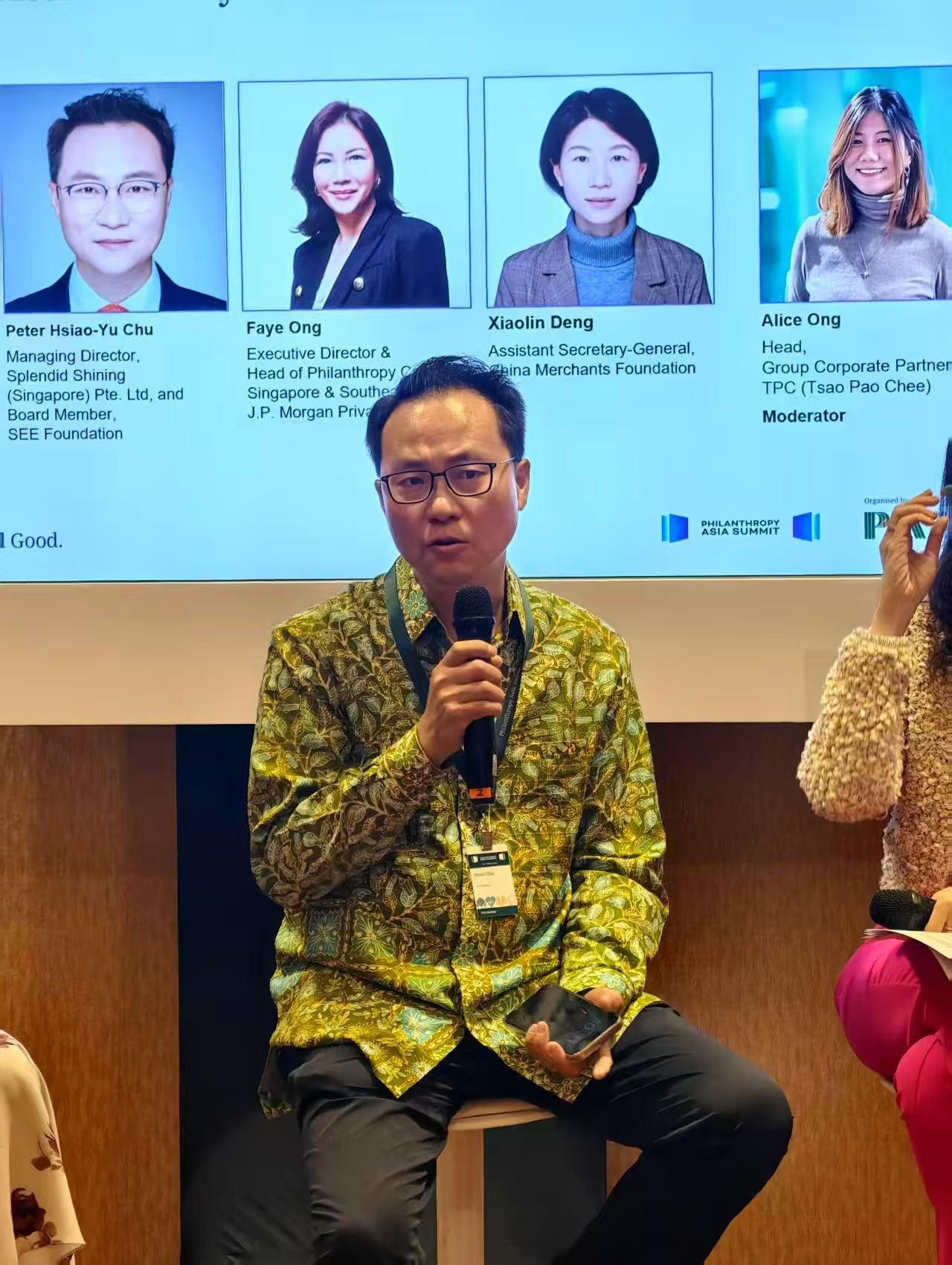
Above: Peter sharing SEE Society insights at Philanthropy Asia Summit 2026.
He said that the global climate crisis demands solutions that extend far beyond traditional charity. While funding remains critical, a significant barrier to environmental preservation is the implementation gap. Fragmented local projects often fail to achieve scale, while capital stays concentrated in low-risk, short-term ventures. Bridging this divide requires systemic infrastructure capable of connecting resource providers, scientific expertise, and grassroots actors.
Enter the SEE Society (SEE), a non-profit community of entrepreneurs committed to comprehensive environmental protection. Established via the SEE Foundation in 2008, the organisation fosters a climate-friendly society by lowering barriers to philanthropic participation across diverse sectors.
SEE operates at the systemic level rather than just funding individual projects. It works with real estate procurement companies, industry experts and suppliers to establish green procurement standards, driving systemic changes across entire supply chains.
Through its initiatives, SEE offers a robust support network that mimics angel investing in the business sector. Programmes like Green Creators and Green Grass Partners provide early-stage and growth-stage environmental organisations with:
financial capital;
strategic diagnosis;
standardised training courses; and
peer mentorship.
A central challenge Peter highlighted in China and across Asia is the "insufficient capacity at the middle level" of the environmental ecosystem. Frontline social organisations possess invaluable local experience but frequently lack standard methodologies, organisational management skills and stable long-term funding. This causes information asymmetry, preventing successful environmental initiatives from being replicated or scaled across different regions.
Peter emphasized the need for philanthropic capital to pivot from simply acting as a funder to becoming a long-term partner. True ecological sustainability, he said, requires building connection mechanisms that blend entrepreneurial business acumen—such as organisational development and systems thinking—with frontline environmental research and execution.

Above: Peter with Saudi Princess at New York Climate Week 2025
To address these systemic vulnerabilities, Peter shared about the China Climate Philanthropy Partnership Program, launched by the SEE Foundation, which focuses on three core pillars designed to drive collaborative climate solutions:
Community Networks: Building a credible, cross-sectoral network connecting entrepreneurs, philanthropists, social organisations, and professional institutions.
Structured Learning: Facilitating dialogue around long-term strategies, practical data, and case study failures to lower entry barriers for new donors.
Scalable Action: Fostering cross-regional pilot projects that turn fragmented local explorations into expanding, reproducible regional climate models.
Asia accounts for a massive share of global emissions and future energy demand, revealed Peter. Fortunately, he noted, there is a rising generation of first-generation wealth creators and high-net-worth families, who are demonstrating an openness to integrating sustainability directly into their giving.
By channeling this capital into structured, intermediary networks, Peter calls on green philanthropy to catalyse the cross-border and cross-sectoral alliances necessary to protect our shared environment.